
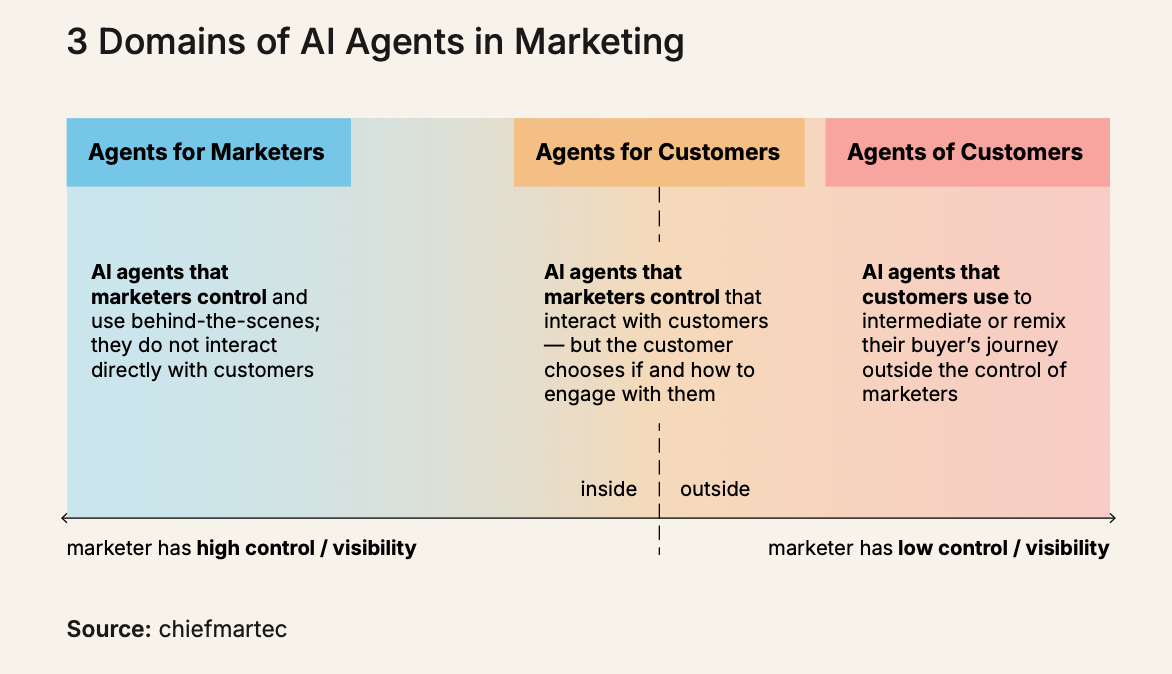

The data is the most precise snapshot we have of where AI agents are actually being deployed in marketing today. Internal agents are accelerating production through marketing automation and data analytics, lightening workload while improving accuracy. Customer-facing agents are handling volume and engagement. And external agents — the ones customers control, like ChatGPT and Perplexity — are quietly becoming a shadow operating system for how buyers discover and evaluate brands.
However, as I studied the charts and listened to the sessions, a pattern began to emerge. The survey shows that we’re maturing rapidly at both the tool and process levels. This deep maturity sets the stage for the next great frontier: the constitutional layer. That’s the architecture that keeps AI decisions auditable, repeatable and aligned with brand identity as agents multiply across the stack. That frontier is where the next wave of competitive advantage will be won or lost.
What is AI in marketing today?
Brinker and Riemersma organized AI agents into three clean domains:
- Agents for marketers: Internal tools that accelerate work behind the scenes (content production, audience segmentation, competitive analysis, ad optimization).
- Agents for customers: Systems that companies deploy and control, but that interact directly with buyers (chatbots, shopper concierges, AI SDRs, email marketing automation).
- Agents of customers: AI assistants that customers control to navigate their buying journey outside of any single brand’s reach — fielding queries, comparing options and making predictions about fit.
The survey shows deployment still leans toward internal agents, with content-production tools leading at 68.9% adoption. Customer-facing agents follow at 54.4%, while external-facing agents remain uncommon.
Only 63.1% of organizations are publishing AI-optimized content for website discovery and ecommerce visibility and barely a quarter are exposing machine-readable feeds or deep-link APIs that external agents can use.

These adoption patterns reveal an early-stage maturity curve. Organizations have embraced agents as tools, but the underlying governance needed to manage them at scale has yet to materialize. That gap becomes more visible when viewed through the five orders of AI maturity.
Dig deeper: 5 ways AI changed marketing strategy in just one year
What are the 5 orders of AI maturity in marketing?
To understand where the market is — and where it’s heading — it helps to think about AI maturity in marketing as a stack of five distinct orders:
Order 1: Tactical (Tools and agents)
- Content agents.
- Ad placement optimization.
- Data hygiene.
- Chatbots.
- Blog automation.
Most organizations are here, selecting tools from various vendors based on immediate functionality.
Order 2: Process (Data and workflows)
This is about infrastructure: first-mile vs. last-mile data, data unification, warehouse-native stacks and marketing ops evolving from tool admins to use-case onboarders.
Integration of customer data, user data, audience data and analytics platforms from multiple data sources defines success at this layer. The best teams are here, managing big data flows and reducing workload through intelligent automation.
Order 3: Strategic (Journeys and value engineering)
This is Brinker and Riemersma’s Marketing Ops 3.0 world — value engineering, Pareto thinking (where 20% of your tech and content serves 80% of repeatable revenue) and the lab versus factory operating model.
Advanced teams are pushing into this layer with strategic segmentation, personalization at scale, workflow orchestration and prediction tools that help them grasp which customer journeys drive loyalty and long-term value.
Order 4: Constitutional (Brand identity and governance rules)
This is the emerging layer. It’s about codifying brand red lines, permission boundaries and decision guardrails in machine-readable form so that every downstream agent — internal, customer-facing and external — inherits them automatically.
Without this, every new tool requires manual governance negotiation. With it, governance becomes infrastructure and algorithms operate within defined boundaries, mitigating bias and ensuring that input from diverse data sources is evaluated against consistent brand standards.
Order 5: Sovereign (Brand and moat)
This is the endgame. When governed intelligence itself becomes the moat — trust compounds, pricing power strengthens, regulatory resilience turns into competitive advantage and institutional memory encodes into systems that survive personnel turnover and technology shifts.
At this level, organizations possess deep expertise in managing AI across every variant of their operations and their constitutional architecture becomes a strategic asset that competitors and vendors cannot easily replicate.
Dig deeper: Most AI agents fail without data and governance maturity
How do the Martech 2026 charts reveal the Order 4 gap?
Let’s revisit three key slides from the keynote through this framework.
The survey shows that 80.6% of deployed agents operate in “assist only” mode, where AI suggests and humans decide. Another 37.9% run in “execute with approval” mode, where AI proposes an action and waits for human sign-off.
On the surface, this appears to be responsible governance — and it is. Humans have heroically bridged the gap so far. But to scale Brinker’s vision of value engineering, we need to graduate from manual approvals to constitutional architecture.
Every approval decision is currently a one-time judgment call. There’s no reusable pattern. No institutional memory, and no way to audit why one human approved and another didn’t. When you add your fourth, seventh, 12th AI-powered tool, you’re not inheriting governance — you’re renegotiating it from scratch.
That is Order 2 thinking applied to an Order 4 problem. It works until scaling breaks it.
What does the $750 billion external agent disruption mean?
McKinsey’s findings reinforce the urgency: external agents are becoming powerful intermediaries between brands and buyers.
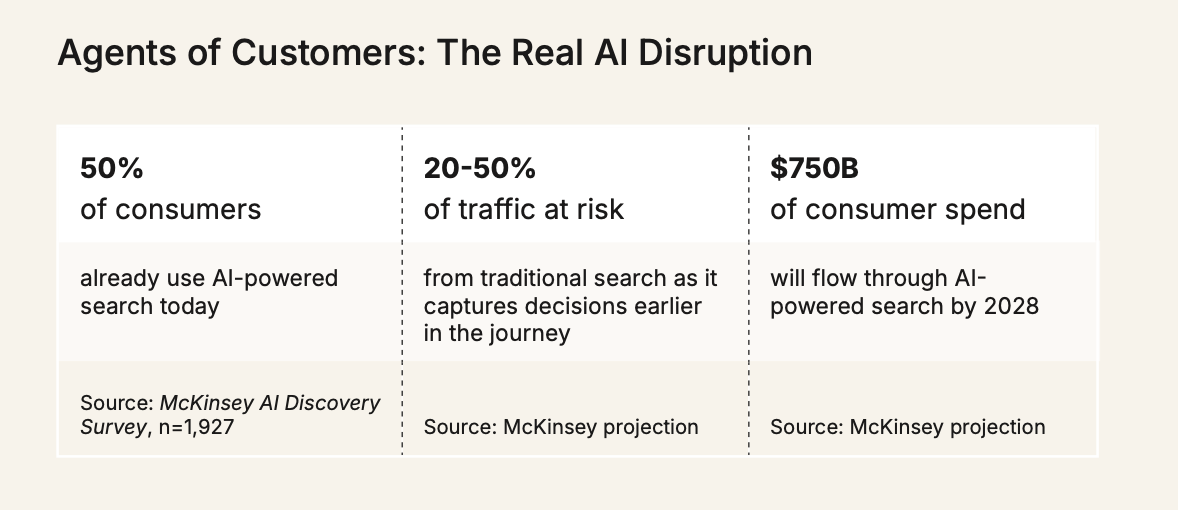
The survey shows the gap clearly. Only 63.1% are publishing AI-optimized content (structured Q&A, schema markup), and barely 17.5% are exposing machine-readable product feeds or providing MCP servers that external agents can query for accurate, real-time market data.
Here’s the Order 4 opportunity: External agents will act as a shadow OS for your brand whether you architect for them or not. They’ll scrape your website, remix your content and answer buyer queries — potentially with outdated data, competitor language or outright hallucinations.
A constitutional layer that defines how your brand should be represented in machine-readable form turns this risk into an advantage — you author your identity proactively rather than letting external agents write it by default.
Why does AI slop keep growing in lab and factory models?
Brinker and Riemersma describe two operating modes for martech stacks:
- The laboratory — where you experiment with new journeys, test problem-market fit and explore personalization strategies.
- The factory — where you scale proven, repeatable journeys with predictable economics and marketing automation.

Innovative teams run both in parallel. The challenge: without a shared constitutional layer, labs and factories each invent their own governance rules. The lab says, “Move fast, test everything.” The factory says, “Don’t break what’s working.” The collision shows up as rework, brand inconsistency and what one speaker called AI slop — content and decisions multiplying faster than teams can govern them.
This is the reconciliation tax: the hidden cost of ungoverned AI, which appears as unexplained budget overruns, compliance risks and brand drift. It grows exponentially as you add agents, because every new tool requires manual coordination with every existing one. As I explored in “Your AI strategy is stuck in the past — here’s how to fix it,” the difference between getting stuck in pilot purgatory and achieving scalable success lies in moving beyond scattered experiments to governed, end-to-end workflows.
Order 4 is the glue. It’s the layer that lets labs experiment safely (because brand red lines are enforced automatically) and factories scale confidently (because governance patterns are reusable, not rebuilt every time).
What is the constitutional layer and how do you build it?
- Encodes brand identity and decision guardrails once so every agent inherits them automatically.
- Produces instant, defensible receipts for any AI-assisted decision — exportable for regulators, customers or the board with complete transparency.
- Prevents collisions when adding more AI-powered tools without requiring renegotiation of governance each time.
This is the Order 4 bridge. And it’s buildable. The architecture I call the Brand Experience AI Operating System (BXAI-OS) is built on three foundational pillars.
Pillar 1: Constitutional enforcement
Specific brand red lines and decision guardrails are enforced before any AI acts, not after. When an agent proposes an action that crosses a boundary — offering a discount that erodes margin, using competitor language, making a promise the company can’t keep — the system pauses, escalates with a documented rationale and waits for human resolution. Decisions resume only after review.
This functionality ensures accuracy, mitigates bias in AI input and protects customer data integrity. It prevents the hidden AI risk that could break your brand.
Pillar 2: Glass-box evidence view
Every decision produces a tamper-evident receipt: source lineage, applied guardrails, confidence level and escalation trail. These aren’t abstract logs buried in systems — they’re exportable artifacts you can hand to a regulator, a customer or your CFO in minutes.
Speed without receipts is just undocumented chaos. Speed with receipts is governed velocity and operational transparency. This evidence trail enables stakeholders to understand precisely how AI-generated predictions were derived and which data sources informed each decision.
Pillar 3: Shadow ledger and reconciliation tax
Most organizations fail to measure the hidden cost of ungoverned AI: the rework cycles, the compliance scares and the brand collisions that manifest as mysterious budget overruns. Quantifying this shadow ledger turns governance from a risk-mitigation expense into a velocity investment — because you’re eliminating waste that’s already bleeding the profit and loss (P&L) statement.
Together, these three pillars create the constitutional infrastructure that lets you scale Orders 1–3 with confidence.
How does Order 4 governance unlock velocity in Orders 1–3?
Here’s the reframe: Governance isn’t bureaucracy, it’s the architecture that enables velocity.
For labs: Experiment aggressively because the constitutional layer catches red-line violations before they compound. You can test faster because guardrails are automated, not negotiated. Personalization experiments, email marketing campaigns and ad placement tests run with built-in safety rails. Test different variants without fear of brand drift.
For factories: Scale repeatable journeys without renegotiating governance or rebuilding decision logic. Each new workflow inherits constitutional patterns from the previous one, so deployment time drops from months to weeks. Marketing automation becomes more reliable and integration with CRM systems and analytics platforms happens cleanly. Workload decreases as governance becomes reusable infrastructure rather than custom negotiation.
For Marketing Ops 3.0: Brinker and Riemersma argue that marketing ops is evolving from “tool admins” to “value engineers” who focus on the Pareto balance — where 20% of your tech serves 80% of repeatable revenue. Order 4 gives value engineers the metrics and levers they actually need: quantified reconciliation tax, reusable governance templates and instant audit capability that turns compliance from a bottleneck into a checkbox. It demands expertise in both technology and brand strategy, but the payoff is substantial.
Tie this back to the keynote’s efficiency/effectiveness chart: Order-4 architecture is what lets you reliably transition from “do more with less” (scarcity-driven experiments) to “do more with more” (compounding profit at scale). Constitutional infrastructure turns agent proliferation from chaos into compound advantage.
What should CMOs actually do about AI governance in 2026?
Start with one high-value workflow from your 80% revenue band — the repeatable journeys that drive the bulk of your business. Then:
- Map the reconciliation tax: Where do brand collisions or compliance risks currently emerge? How much leadership time gets burned reconciling contradictory AI outputs? Quantify it.
- Define 3–7 brand red lines: What decisions must never be violated, no matter what any AI proposes? Examples: “Never promise a feature that’s not on the approved roadmap.”
- “Never offer a discount that erodes margin below 20%.”
- “Never use competitor language or slang in premium-brand contexts.”
- Implement simple receipts: For key AI-assisted decisions, generate a basic record that includes the following details: the rule applied, the user or customer data used, the confidence level that triggered the action and who approved any overrides. Make it exportable so you can explain it to regulators, boards or customers in minutes, not weeks.
Then replicate that pattern to the following 2–4 business cases, mirroring the Pareto/productization advice from Brinker’s keynote. This doesn’t replace his guidance — it completes it by providing a reusable constitutional pattern that scales.
From Martech 2026 to Governed Intelligence 2027
The data make clear that 2027–2028 will be defined by who builds Order 4 constitutional architecture to support that momentum. It is essential as AI search intensifies, regulations tighten (Colorado and California are already moving) and customer expectations shift toward brands that can explain their AI decisions in plain language with full transparency.
The companies that architect governance as infrastructure will move faster, scale more cost-effectively and defend themselves more easily than competitors still managing governance through manual approval workflows and paying the reconciliation tax every quarter. They’ll build loyalty not just through better prediction tools, but through trustworthy, auditable AI that customers can grasp and rely on.
Dig deeper: 3 actions you must take to thrive in the agentic era of marketing
Key takeaways
- Martech 2026 mapped Orders 1–3 brilliantly: The survey shows where teams are deploying tools (Order 1), building process infrastructure with data analytics and marketing automation (Order 2) and thinking strategically about value engineering (Order 3).
- Order 4 is the missing constitutional layer: Without machine-readable brand guardrails, every new AI tool requires manual governance renegotiation — creating reconciliation tax and AI slop.
- BXAI-OS offers a 3-pillar solution: Constitutional enforcement (brand red lines enforced before AI acts), glass-box evidence (instant audit receipts with transparency) and shadow ledger visibility (quantifying hidden governance costs).
- Order 4 enables velocity, not bureaucracy: Labs experiment safely, factories scale confidently and Marketing Ops 3.0 gets the metrics and expertise to be true value engineers.
- Start with one core revenue workflow: Map the reconciliation tax, define 3–7 red lines, implement simple receipts, then replicate the pattern across 2–4 business cases.
Fuel up with free marketing insights.
Contributing authors are invited to create content for MarTech and are chosen for their expertise and contribution to the martech community. Our contributors work under the oversight of the editorial staff and contributions are checked for quality and relevance to our readers. MarTech is owned by Semrush. Contributor was not asked to make any direct or indirect mentions of Semrush. The opinions they express are their own.